
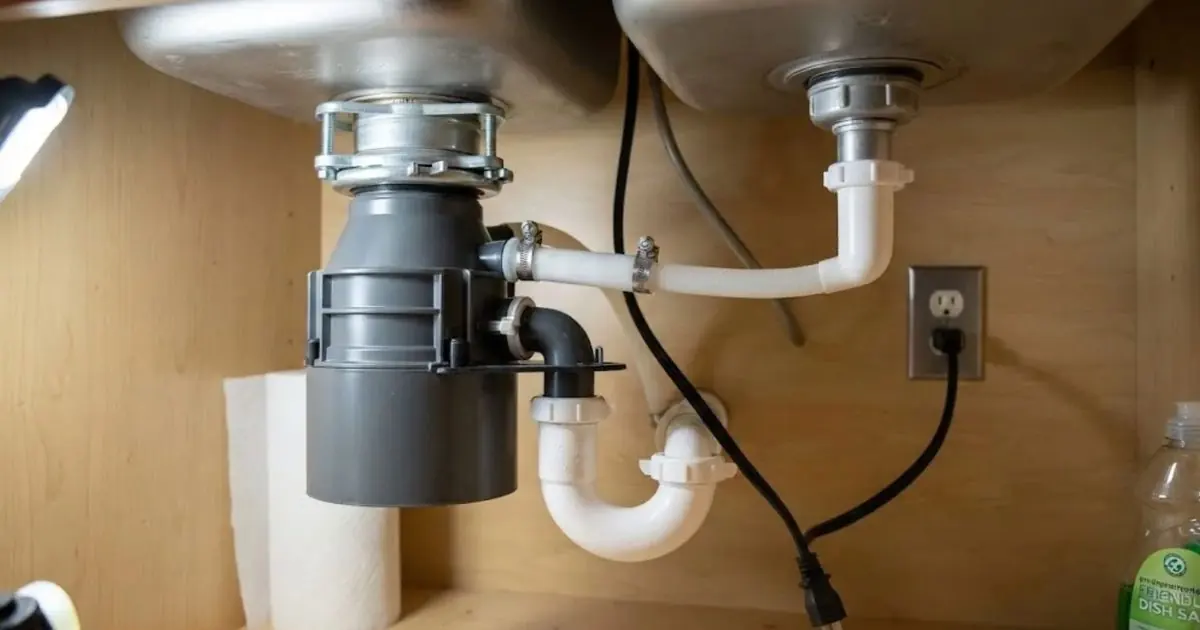
How the Pieces Fit Together
A disposal bolts to the sink's drain opening and drops into the trap arm below. The dishwasher drain hose connects to a small inlet on the side of the disposal. A two-bowl sink adds a second drain that joins the disposal's discharge or runs to a shared tee.
Knowing this layout helps you see why a disposal install is more than screwing in a motor. The drain, the dishwasher line and the electrical supply all have to work together.
What You Need Before Starting
A quick check of these five items avoids most mid-job surprises.
| Item | Why it matters | Check first |
|---|---|---|
| Power | The disposal needs a switched outlet or hardwired supply | Location of the outlet or switch |
| Sink flange | Seals the sink to the disposal | Compatibility with the unit |
| Dishwasher connection | Drains through the disposal inlet | Knockout plug removed if needed |
| Trap and drain line | Must align with the discharge | Condition and slope |
| Under-sink space | Disposals are bulky | Room for the unit and tools |
The Installation Steps
Electrical work and trap alignment are where mistakes happen.
- 1Turn off the power and clear the cabinetSwitch off the breaker and remove everything under the sink.
- 2Remove the old drain or disposalDisconnect the trap and take out the old flange assembly.
- 3Mount the new sink flangeSeat it with plumber's putty or the gasket and tighten the mounting ring.
- 4Hang the disposalAttach the unit to the mounting ring and rotate it so the outlet faces the drain.
- 5Connect the dishwasher hose and the drainRemove the knockout plug if the dishwasher connects here, then attach the hose and the trap arm.
- 6Wire it, test and check for leaksConnect the power, then run water and watch every joint.
The Knockout Plug Mistake
New disposals often have a plastic plug in the dishwasher inlet. If you connect the dishwasher without knocking that plug out, the dishwasher cannot drain. Many callbacks start here.
Use a screwdriver and a hammer to knock the plug out from the inside, then fish the piece out of the chamber.
Mind the Wiring
If there is no switch and outlet under or near the sink, an electrician may need to add one. Do not run the disposal off an extension cord or leave the power connected while working.
What Not to Grind
A disposal handles soft food scraps with plenty of cold water. Grease, coffee grounds in bulk, fibrous vegetables and bones cause jams and clogs down the line. Run cold water for a few seconds before and after each use.
For repair questions, garbage disposal repair and installation has details, and drain cleaning helps when the line downstream clogs.
Dishwasher Drain Loops and Air Gaps
The dishwasher drain hose should rise high under the counter before it drops to the disposal inlet. That high loop keeps dirty sink water from flowing back into the dishwasher. Some fixtures use an air gap on the countertop instead.
Check how your existing hose is routed before you reconnect it. A hose that runs low and flat invites a backflow problem and a smell inside the dishwasher.
Sizing the Disposal
Disposals are rated by motor strength. A small unit suits a single person or a couple who cook little, and a stronger motor suits a family that cooks daily. A bigger motor also grinds more quietly and jams less.
Check the mounting style, since some units use a quick-lock ring and others a three-bolt mount. Match the new unit to the sink flange you have, or plan to replace the flange at the same time.
Common Leaks After the Install
The most common leaks after a disposal install come from the sink flange, the mounting ring and the slip nuts on the trap. Run water for a full minute and feel each joint with a dry paper towel. Check again an hour later, since a loose gasket sometimes weeps slowly.
A drip from the unit body itself, not a joint, means a cracked housing or a failed internal seal. That unit needs replacement.
When to Hire a Plumber
Hire a plumber when the drain stub is corroded, when the old trap does not line up or when there is no switched power at the sink. Hire one when the sink is in a finished kitchen and a leak would damage cabinets and flooring. The visit is short and the testing is part of the work.
A plumber also checks the downstream drain for slow flow. A disposal sends more solids into the line, so a half-clogged drain shows up quickly.
Kitchens in Shrewsbury Homes
Shrewsbury has a wide range of housing, from early twentieth-century houses to newer builds. Older kitchens may have galvanized or cast iron drain stubs that do not match modern disposal fittings.
Ask the Shrewsbury building department whether a permit or electrical inspection applies to your kitchen work. They can answer for your address and the scope of the job.
Disposal Jammed or Not Draining?
Call and a plumber can install a new disposal or repair the one you have.
Nearby Towns
We handle disposal installs for homes in Northborough and Boylston, including homes on septic systems where grease control matters even more.
Disposal Installation Questions
A handy homeowner can, but the wiring, the trap and the dishwasher connection all need care.
Many kitchens do not have a switched outlet under the sink. An electrician can add one.
Heavy use can add solids to the tank. Check with your septic professional before adding one.
The knockout plug in the disposal inlet may still be in place.
Rules can vary. Ask the building department about your job.