
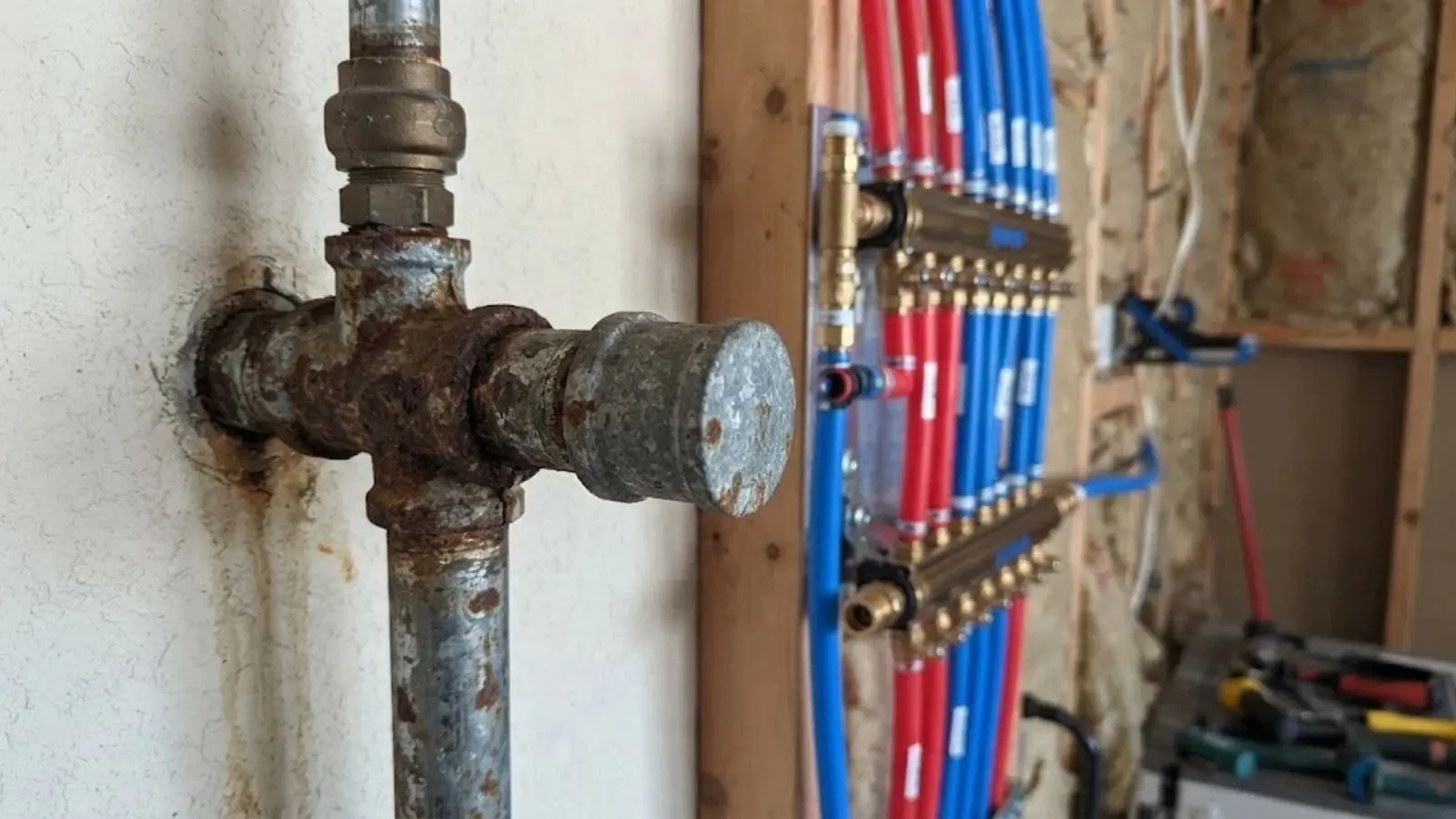
When Pipes Are Worn Out, Not Just Leaking
One leak is a repair. Several leaks in a short time, water that comes out brown and pressure that gets worse every year point to pipe that is failing along its whole length. At that point repairs cost more than replacement over time, and every patch weakens the neighbors.
Repiping replaces the supply lines that carry water to fixtures, and drain lines are a separate matter. A leak detection visit helps decide whether a single section failed or the whole system is tired.
Signs It May Be Time to Repipe
The pattern matters more than any single symptom.
- Brown or rust-colored water: especially when it runs first thing in the morning.
- Falling water pressure: galvanized pipe narrows inside as rust builds up.
- Frequent pinhole leaks: copper can develop them from inside or from water chemistry.
- Visible corrosion at fittings: green or white crust shows a joint is failing.
- Old pipe material: galvanized steel and old polybutylene are known problem materials.
Pipe Materials: What You Have and What Replaces It
Knowing the material tells you most of what you need to know about the risk.
| Material | Typical era and issue | Usual replacement |
|---|---|---|
| Galvanized steel | Early and middle 1900s, rusts shut from inside | PEX or copper |
| Copper with lead solder | Joined with lead solder before the mid-1980s | New copper or PEX |
| Polybutylene | Used in some homes in the late 1970s to mid 1990s, can fail at fittings | PEX or copper |
| Newer copper or PEX | Usually sound unless a fitting fails | Repair, not repipe |
Shrewsbury Houses and Galvanized Pipe
Shrewsbury's population roughly doubled between 1915 and 1940, and houses from that building boom were often plumbed in galvanized steel. That pipe can last decades, but it corrodes from the inside and eventually chokes. If your house is of that age and the pressure has been slipping, a repiping assessment is worth the call.
Some of those houses were already partly repiped in copper, so a mix of materials is common. We inspect what you have before recommending a full or partial repipe.
How a Repipe Goes
A repipe is organized work, not demolition.
- 1Assess the system.The plumber traces supply lines, finds valves and checks wall access.
- 2Plan the route.A new manifold and PEX runs often follow existing paths to limit wall openings.
- 3Replace the lines.New pipe is run to every fixture, and old pipe is removed or abandoned.
- 4Test and restore.The system is pressure tested, then the small openings are closed up.
- 5Inspection and permit.The inspector reviews the work as required by Massachusetts plumbing rules.
A partial repipe can replace only the worst section, such as a failed run behind a bathroom. If one pipe has already burst, start with burst pipe repair.
Partial or Whole House?
A partial repipe makes sense when one area is failing and the rest is newer. A whole-house repipe makes sense when pipe throughout is the same old material or leaks keep appearing in different places. Doing it all at once costs less per foot and avoids opening walls twice.
The same questions come up in Northborough, where many houses have copper of mixed ages, and in newer homes the answer is usually a repair, not a repipe.
What Shapes the Cost of Repiping
Repiping is planned work, and you get a clear price before work starts.
Insurance generally does not pay for repiping because worn pipe is a maintenance item. Resulting water damage from a sudden leak may be covered. Want your real number? Call (508) 389-4045.
Ready for an Assessment?
Call and tell us the age of the house and what you have seen. We will schedule a plumber, with same-day appointments offered when open.
What to Do Before a Repipe Starts
Clear the access areas, protect floors and plan for a day or more without full water service. Do not cut open walls yourself to look, since old galvanized and lead-era fittings can fail when disturbed.
Replacement piping and connections are installed to the state plumbing standards, set out in 248 CMR 10.00, and your plumber can explain which materials are acceptable.
Repiping Questions in Shrewsbury
Galvanized pipe is gray and attracts a magnet. It is common in houses from the early and middle 1900s.
Many take several days, depending on the size of the house and access. We give a schedule with the price.
Small openings are usually enough when routes follow existing paths. Some patching is part of the job.
Both are used widely in Massachusetts homes when installed to code. We explain the trade-offs for your house.
Plumbing work in Massachusetts normally needs a permit pulled by a plumber, and the inspector checks the work. Ask the Shrewsbury building department if you want to confirm.
Yes, a partial repipe can address one problem area while leaving newer pipe alone.